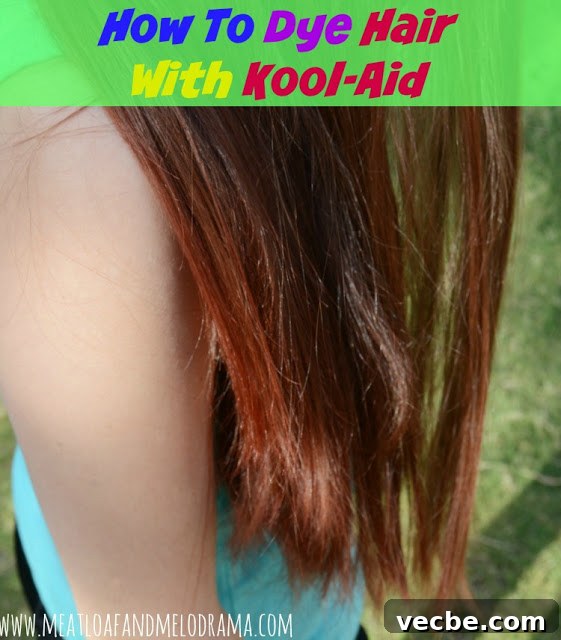
Hi everyone! My youngest has been begging to try a temporary hair color before school starts. With only a couple of weeks left of summer, she wanted to squeeze in as much fun as possible. Last year she asked about Kool-Aid hair dye, but we only had food coloring on hand, so that’s what we used.
This year she reminded me to pick up Kool-Aid when we were at the store, so we decided to experiment at home. Since many readers ask how dyeing hair with Kool-Aid works, I’m sharing what we learned, the methods we tried, and tips for the best results.
My daughter goes to summer dance class, and the girls love showing off colorful streaks when they arrive. When we used food coloring last year the hues were bright but faded almost immediately, which meant daily touch-ups. Kool-Aid is often recommended as a longer-lasting, temporary alternative, so we thought it was worth a try.
We bought cherry and grape flavors and tested two simple methods to compare color intensity. For the cherry, I boiled about two cups of water and stirred in the Kool-Aid powder until the liquid was a deep red, then allowed it to cool in a glass bowl. For the grape, we mixed the powder into cool water in a plastic container. My daughter mentioned that using hot water usually yields a richer dye, while mixing with cold water gives a softer shade.
To apply the dye, we dipped just the ends of the hair into the Kool-Aid for a few minutes. My daughter handled the side strands and I helped with the back. The back section stayed in the dye a bit longer—about five minutes total—until the color looked right. Make sure to protect clothing with an old towel, as the dye can be messy. After dipping, we patted the hair with paper towels and used a blow dryer to finish drying and help set the color.
Ends and previously damaged hair tend to absorb more pigment, so you’ll often see the brightest color at the tips. My daughter loved her vivid red tips—just the playful accent she wanted.
My other daughter tried the grape on her blonde hair. Because we used cold water for the grape mixture, the result was a very soft, almost pastel purple—more subtle than the cherry red. If you want a more vivid result on light hair, try using hot water, leaving the dye on a bit longer, or repeating the process.
One advantage we noticed is that Kool-Aid held up better than the food coloring we’d used previously. It didn’t wash out immediately—even after swimming and a shower, the color was still visible the next day at dance practice, which thrilled my daughter. As with any temporary dye, the shade will gradually fade after several shampoos.
If you plan to try this at home: protect clothing and surfaces, test a small section first, and choose your method—hot water for richer tones, cold water for softer shades. This is a fun, inexpensive way to experiment with temporary hair color while summer lasts.
Thanks for reading, and enjoy your colorful experiments!
You May Also Like